

Some people seem to be natural doers. When there’s something that needs doing – a table to be cleared, or a flowerbed to be weeded — they get uncomfortable and start doing it.
Natural doers are mysterious creatures to me, but I have met and observed many of them. Doing seems to be their most natural response to existence. Even if the task is in some way objectionable, its not-doneness is apparently more objectionable. So they start the doing process and this appears to give them some relief. The gravity in the doer’s inner world seems to draw them in the direction of action.
Of course, everyone understands the rewards of getting things, by whatever means, to a state of doneness — even those of us who live in an inner world with reverse gravity. Doing is vital. It’s the only way to express ourselves, maintain our households, and create things that improve people’s lives.
So for those of us who have always struggled to get a reasonable volume of stuff done, whether it’s because of ADHD, depression, or natural temperament, the prospect of becoming a productive person is extremely appealing. A sustainable productivity method is our holy grail. It would unlock vast tracts of life that have always seemed off-limits to us.
The Gold Standard
In my own quest for the grail, there probably isn’t a book I’ve read more times than David Allen’s landmark book Getting Things Done. It presents a watertight system for gathering all of your obligations into a giant funnel, and cranking them through a coordinated workflow system so that pure success gushes out the bottom.
I love the system, and I’ve spent much of my adult life fantasizing about having it in place. And several times, I have — for about 48 hours. Then at some point I forget to check a few of the interconnected lists and folders, and soon my watertight system has become another pile of papers with important things written on them that I will get to someday.

This pattern seemed to happen with every productivity book I tried, even the very best ones like Deep Work, Atomic Habits, and The Pomodoro Technique. I would read and reread these books with great enthusiasm, and learn a lot from them, but never seemed able to implement their systems as an ongoing thing. There are just too many moving parts you have to get right at the same time.
That might be entirely my fault, as a productivity non-natural, but knowing that doesn’t solve anything. I also don’t think I’m that unusual in my chronic inability to convert the written wisdom of David Allen or Cal Newport into a sustainable, self-directed way of working. Something is missing from the “how to be productive” discussion.
How the Other Half Works
In my old age I think I’ve figured out what it is that’s missing, and why. Perhaps not coincidentally, I’ve also worked out my own way of getting things done. Not at superstar level, but consistently enough to always be gaining ground.
I believe there are two reasons some of us don’t do well with the popular workflow approaches. The first is basic selection bias. Mass market books are always gargantuan projects, each of which depends entirely on the timely output of one self-starting person. It also takes some productivity-related clout to even get the book deal, so productivity books tend to be written by natural doers. These authors certainly have useful things to say on the subject, but they’re unlikely to be attuned to the specific struggles of the people in most desperate need of effective productivity advice. That’s why so many of the books focus on organizing and scheduling the work – they assume you have no problem with the doing part.
I got a big clue to the other reason after buying Francesco Cirillo’s The Pomodoro Technique. A reader had already told me the central idea: work in timed, 25 minute sprints, tolerating no diversions or interruptions. These periods are long enough that you get something significant done, but too short to rationalize wasting even one minute of them. Try to do a lot of them in a day.

When I bought the book, I found that many moving parts had been added to this elegant concept, including multiple tracking sheets, a notation system, and other pieces I wasn’t sure I could leave out. These structures seemed so superfluous that it occurred to me that they had not been included to strengthen the core concept, but to make a simple concept into a full-length book.
This inference might not be correct – only Mr. Cirillo can tell you that – but the experience awakened me to a truism about how-to books: they always contain too much advice to implement. The typical how-to book is 200-something pages, and I think the sole reason for that is that publishers don’t know how to sell them if they’re any smaller. The Pomodoro Technique is relatively lean, at about 150, and it’s that much better for it.
The Bandwidth Problem
I believe the standard how-to book contains too much new stuff for a human brain to take on board once, or at least it does for my brain. Implementing a single habit – flossing before bed, for example – is something most people can do if they’re really focusing on it, but even that is hard. Converting your workday into the full-bore Pomodoro system, or (God help you) the GTD system, represents a dozen or more habits that all have to come online more or less at the same time.
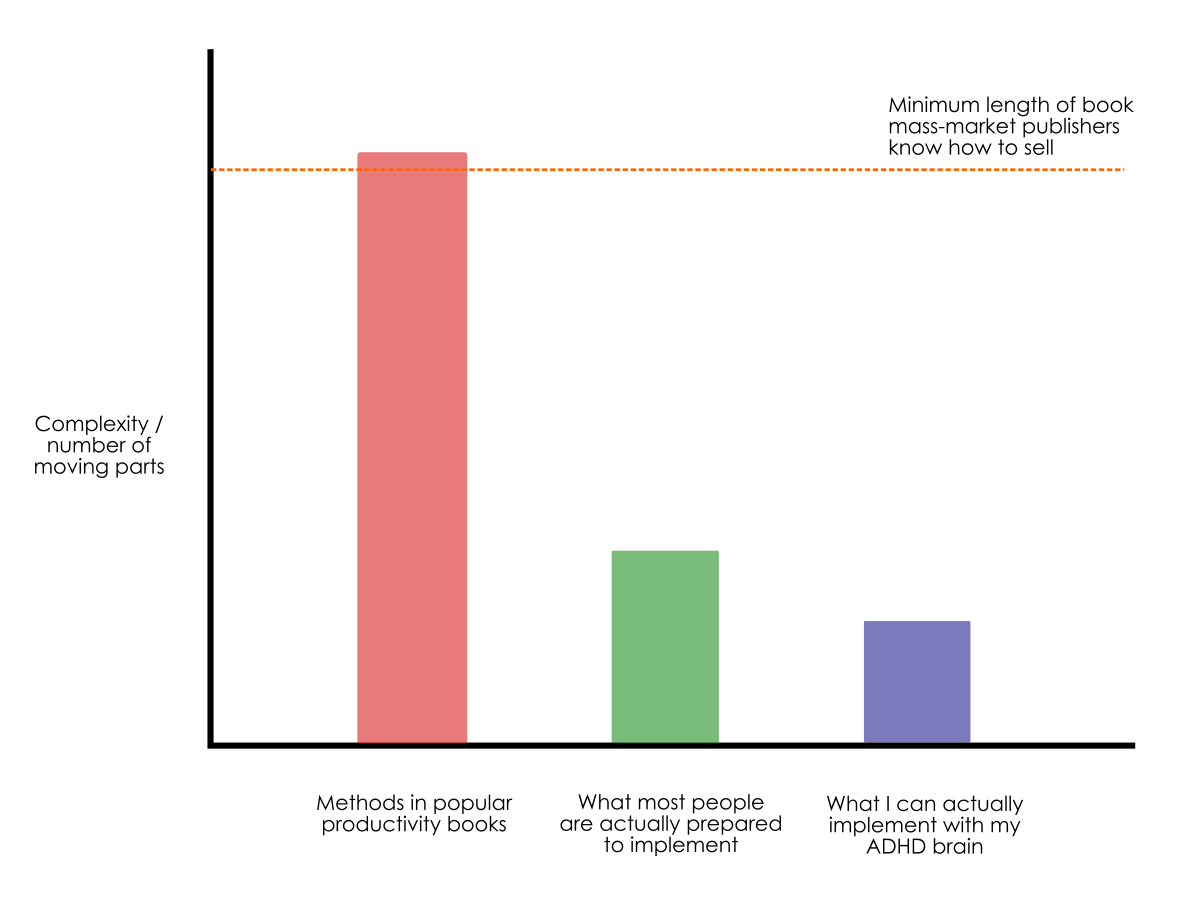
What all this means is that how-to resources of the best size and scope – the size that would help the most people, especially those who need the most help – don’t seem to exist.
I always wished they’d offer us thirty good pages – the pivotal concept that made them write the book, the steps needed for even a hard case like me to get it up and running, and nothing else. For that I would pay double, and probably buy the sequel too.
It turns out that, given simpler tools, we non-naturals can get things done. We have to do it a different way though. Instead of aspiring to become a ringmaster and expert plate-spinner like David Allen, we can become a sort of expert one-trick pony, learning one reliable way to get one thing done, and getting very good at it.

That’s what finally worked for me, I’m happy to report to my fellow non-naturals. I do short working sprints, with a running timer in plain view, bookending each session with a few quick preparatory steps in order to keep the quality up. I count how many I do, and try to get better each time.
It’s made a tremendous difference to my output, and now it’s just a matter of getting better at that one sequence. There’s very little to remember, and only one gauge to keep my eye on. It’s enough.
Try it my way
After disclosing my ADHD diagnosis, I received a flood of emails from people with similar executive function issues. Having figured out, in the meantime, my own simple way of getting work done, I decided to create the sort of resource I always wanted someone else to make.
For now it’s a brief ebook, but depending on the early feedback I may polish it into a one-day course or whatever format seems most helpful to people.
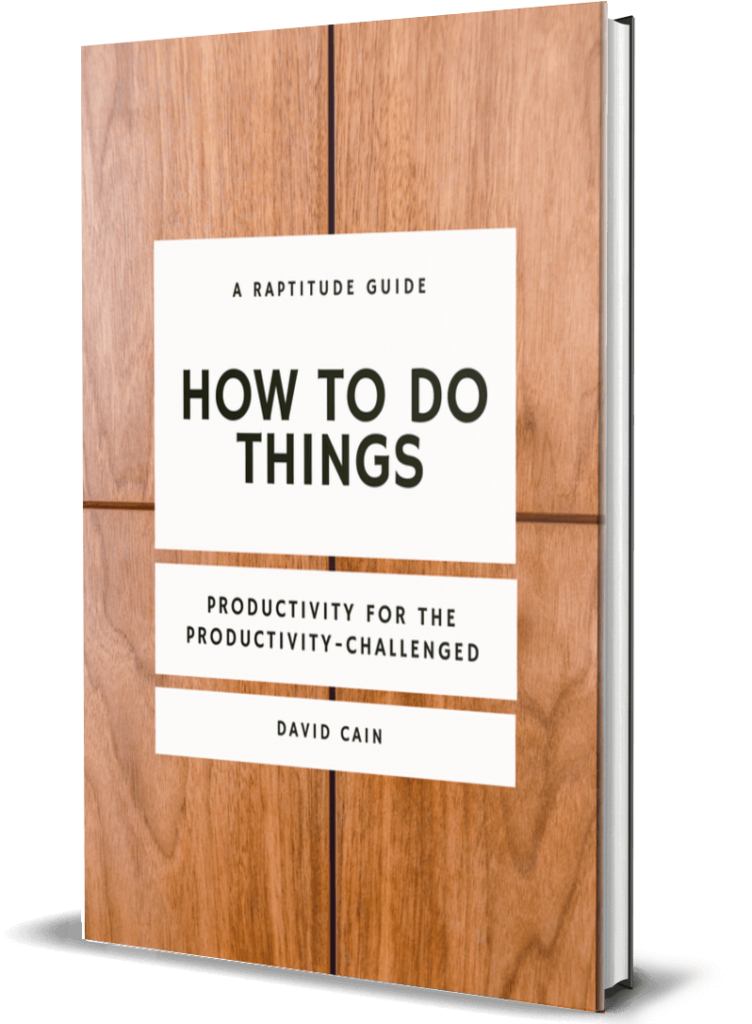
I named it How to Do Things. It’s a guide meant for the productivity non-naturals among us, specifically:
- People who know they use their work time poorly
- People struggling to work from home
- People with ADHD or other executive function issues
- People who haven’t had much success with popular productivity books like Getting Things Done, Deep Work, or The Pomodoro Technique
How to Do Things owes a lot to the above books, which are excellent in their own right. HTDT uses short working sprints, similar to the pomodoro technique, but with a pleasant visual metaphor rather than a fleet of worksheets and processes.
The guide was designed around specific goals for the reader:
- Dramatically increase your productivity
- Create this dramatic increase in a week or less
- Provide the know-how in a resource you can read in one sitting and implement today
What’s a dramatic increase? Something in the range of getting 50% to 200% more done in a day, depending on how much difficulty you’re having.
UPDATE — The initial run of How to Do Things was a huge success, and the guide has been re-released to all. Enjoy!
Try it a different way.
***
Photos by Christina @ wocintechchat and Yulia Khlebnikova. Graphs by David Cain.