

One of the hardest things for a procrastinator is to tackle long-avoided tasks – ones you’ve balked on so many times that they’ve become a “thing” in your mind.
Conquering these tasks is absolutely achievable, even for you, but you do need a system. Here’s how I do it.
This method will work for any project you find intimidating or too complex to easily manage.
Why you’ve been avoiding that thing forever
My hypothesis is that we run from certain tasks not because they’re unpleasant to do, but because they’re unpleasant to think about.
Each person finds it unpleasant to think about certain kinds of work: financial stuff, cleaning up messes, learning tricky concepts, dealing with bureaucracies.
These tasks generate a bit of worry every time you think about them. They don’t just feel like work you have to do; they feel like danger you have to protect yourself from. If you’re not ready when you attempt it, you might screw it up, get overwhelmed, or look like a fool. You might open a can of worms that makes things worse.
These worried thoughts accumulate like barnacles, making the task feel like a nasty little monster in your mind. It’s ugly, unpredictable, and a bit threatening.
So you put it off. But it remains there in the mind, staring at you.

Whenever you think about it – and life will make you think about it — new worries attach themselves. But you still don’t act.
The more you delay, the more mental baggage piles up around it. After a few cycles of hesitation, the task starts to seem like a whole gang of dangers. It’s hard to even look at.
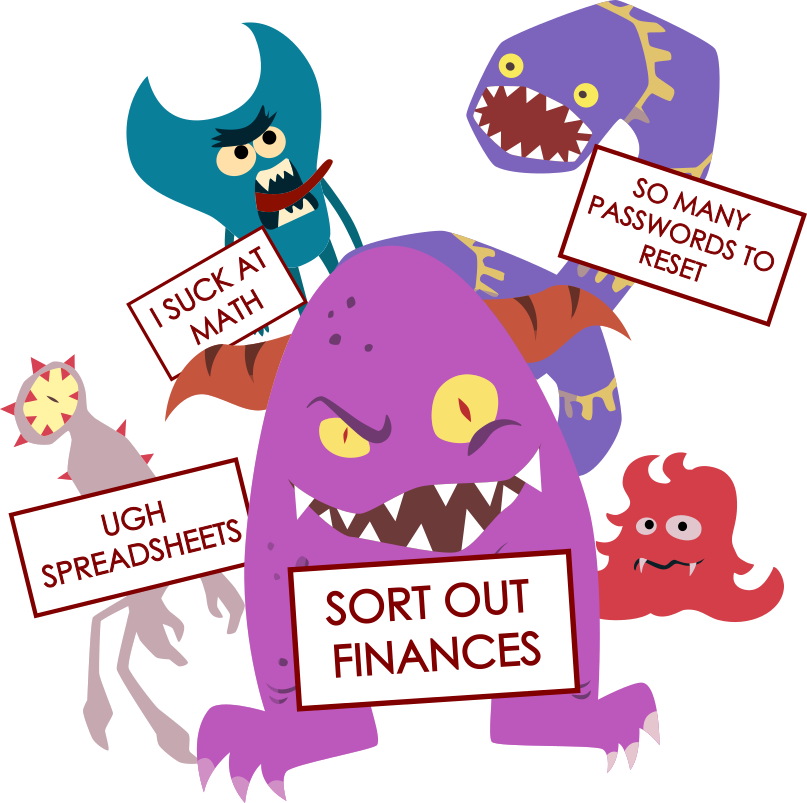
By now it’s become a “thing” in your mind, a gauntlet of hazards, a Big Deal you need to be super ready for. If you attempt this task and encounter any surprises, setbacks, or bad feelings, you will die! You must make sure you’re completely ready!
But… you still can’t help but worry about it. Soon it becomes a whole monster squad that you can’t even begin to think how to deal with.
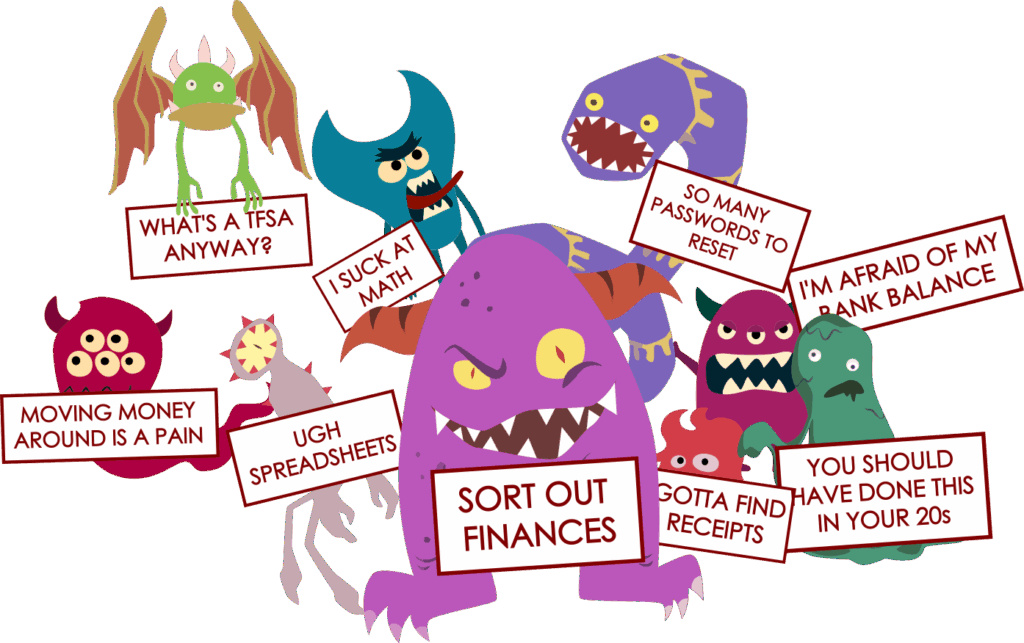
You’re certainly not ready to tackle it yet, and now you need even more readiness than before, because it’s such a huge, dangerous Thing now.
At a certain point, the wise part of you recognizes that you are not headed for the state of perfect readiness you think you need. In fact, you’re only getting less ready. The best bet, as it was from the start, is to do the thing now.
But meanwhile you’ve spent all this time making it worse, and you feel less prepared to deal with it than ever. This self-created hell-state is familiar to all serious procrastinators.
Tasks aren’t real until you start them
Here’s the good news: you can avoid doing battle with the monster squad. That’s because the monster squad isn’t real. It’s a mirage made of accumulated mental baggage – thoughts about the task, not the task itself.
But you can only avoid the battle by starting the task. Once you start a task, the mirage begins to dissipate, because starting a task pulls it out of your imagination and puts it into reality.
The procrastinator’s imagination is a gong show of disorganized worry:

All tasks, in reality, are finite. Concrete. Actionable.
What do you need to do, really? You need to get a list of numbers into a spreadsheet, and figure out three or four formulas. You need to sort through eleven boxes of junk in the storage room. You need to fix three main bugs in your program.
As long as a task remains in your imagination, it is infinite. There’s no end to what must be considered and thought about. It cannot shrink, only grow.
To make the task manageable, you need to get it out of your head and into reality, by physically starting it.
Every task, once you actually get your hands on it, will ultimately resolve itself into some finite number of small, doable actions. You never encounter the deadly, ever-growing monster squad, aka the infinite gloom-cloud, that lives in your head.
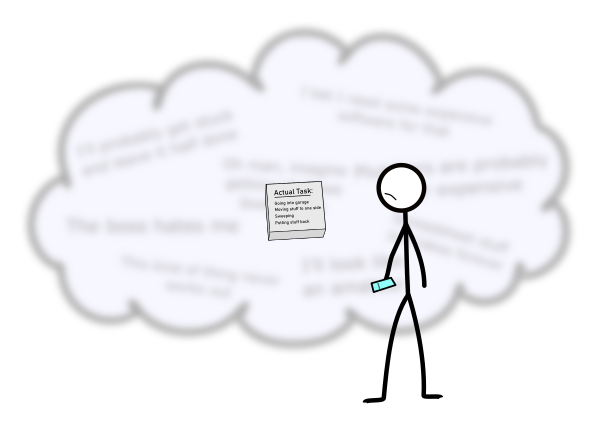

Knowing this principle intellectually is helpful. If you get your hands on the concrete reality of the task, the mental monster squad disintegrates.
However — knowing the principle doesn’t solve the problem, because principles are just more stuff in your head. Only physically starting it solves the problem.
So how do you get your hands on the concrete reality of the task? What’s the first thing you do?
How to get a hold of any project in 20 minutes
Here’s a method for starting tasks or projects that have mutated into worry-monsters in your head. These four steps shouldn’t take more than 20 minutes in total. None of them are very hard.
1. Explain your conundrum in words
Take five minutes and write a fake email to an understanding friend, describing what you want to get done. (If you don’t have any understanding friends, you can write it to any wise or helpful figure: Mr. Rogers, Jesus, Jane Eyre, Gandalf.)
Explain, briefly:
- What you want to get done. What’s the outcome you want?
- What you’re afraid will happen if you try
- What you think will be the tricky parts
Doing this will bring the task into focus, reducing your billowing nimbus-cloud of worry down to a few points of actual, realistic concern. It will also help you feel understood, as you consider your fears through someone else’s mind.

2. Write down what actions the task probably entails, in any order
You can’t know exactly what a task entails until you’re doing it. However, you already have some ideas of what it might entail.
- To clear out the storage room, you’ll probably need to get some garbage bags, choose a place to bring donations, decide where each object should go, and so on.
- To study for the exam, you’ll need to get a list of the topics covered, identify the crucial concepts, find a place to ask questions, and so on.
Just brainstorm actions you’ll probably have to take, in point form. Don’t worry about their difficulty, and don’t think up solutions for potential snags (we have a tactic for that below). Just list some things that probably have to happen.
This process will trigger questions – Is selling things on Ebay worth it? Should I offer some of these old pictures to family members? Include these questions in your list – they often point to actions you need to take. Don’t try to answer them now.

(NOTE: ChatGPT or other AI tools can be helpful for this step. Tell it what you’re trying to do and ask it to suggest actions you might need to take. Don’t use its output as your completed list. Make your list manually, with your own brain, using some of its suggestions if appropriate.)
3. Put the list of actions roughly in order, and call it a “plan for now”
After Step 2, you’ll have a list of actions you might need to take. Eliminate any that have become redundant or unnecessary, then begin putting them roughly in the order you should probably do them.
Turn any questions into actions. “Is selling things on Ebay worth it” might become “Spend ten minutes researching how to sell on Ebay, and make a decision about it.”
You’ll end up with an imperfect but useful list of actions. I call this list a Simple Action Plan. This plan will not be a complete blueprint for success. (You don’t need one.)
Do not try to plan every detail of the project. Doing so will halt you in your tracks, because then you’re just thinking up another monster squad in your head.
You just need enough of a plan to start, and the Simple Action Plan is more than enough.

4. Start doing the steps, breaking down any step that you don’t know how to do
The purpose of a Simple Action Plan (SAP) is to get you moving forward. It does not have to show you the whole route to the end. You only need to see the next lantern on the path.
Starting at the first step, proceed through the actions as you have them written.
When you get to a step that’s too big, too intimidating, or too unclear, break it down into smaller steps.
Break a step down as small as you need to in order to act on it, even right down to “Turn the computer on” or “Reread the professor’s email” if necessary.
If something has to happen first, insert a step.

(The above image is just an example. Only break down the step you are on currently – don’t break down the whole plan at once.)
How to work once you have your Simple Action Plan (SAP)
Your Simple Action Plan is your control room for the project. I keep my SAPs on clipboards nailed to the wall so that I don’t have to look for them. Clipboards with tidy lists on them also make you feel capable and action-ready.
To move the project forward, pick up your SAP, look at the next step, and do it.
If you ever can’t do the current step – it’s unclear, too big, or too scary — that only means you need to break it down further. Turn it into sub-steps as above, or just make a Right Now List. Then go.
Progress is always made the same way:
- Pick up your SAP
- Do the next step
- Break down any step that seems undoable
- Repeat
Actions will lead to obvious next actions. As you go on, you’ll gain a stronger sense of what remains to be done. What’s left will shrink until you’re done.

When your plan feels stale or outdated, make a new one
Since your initial SAP will not be perfect, you may reach a point where it seems stale or outdated. It might include steps you now know are unnecessary, or you may see a better way to proceed.
You’ll know it’s gone stale when you don’t even want to look at it anymore. When this happens, take a few minutes and make a new SAP from where you are.
Do it the same way as before. What actions probably have to happen from the point you’re at? Put them in order, break them down if needed, and so on. Leave out steps you’ve already done.
A fresh new SAP feels amazing. Enjoy the crisp new paper and clearly written (or typed) steps.
Then go! Once again:
- Pick up your SAP
- Do the next step
- Break down any step that seems undoable
- Repeat
This process will take you the whole way.
Use Blocks!
Procrastinators: if you didn’t know, you need to have a way of working in small pieces, or you’ll continue to see big tasks as insurmountable, and have trouble focusing even when you do begin.
Make your tasks into a cluster of easy targets. If you don’t already use the Block Method or something similar for doing that, I strongly suggest you do. You can learn the basics in 3 Secret Weapons for the Productivity-Challenged, or the full art of block-making in the How to Do Things ebook.
Now you have a method. A magic sword. The monsters should fear you.
* * *
Help a fellow productivity-challenged person. Share this guide with someone right now.